Year 1 Findings: How Is Tech Protecting Biodiversity in Ecuador's Pacific Forest?
A guest post by Ecuador's Third Millennium Alliance detailing the findings of the TECH4ALL biodiversity monitoring and protection project in the Pacific Forest.
Located in the heart of Ecuador’s Pacific Forest at the nexus of the Choco Rainforest and Tumbes Dry Forest, Jama-Coaque Reserve (JCR) protects 3,000 acres of threatened forest.
Managed and owned by the Third Millennium Alliance (TMA), JCR is home to what remains of the Pacific Forest - just 2% survives. The vast majority of the area has been decimated by decades of deforestation, leading to the fragmentation of habitats, biodiversity loss, and negative impacts on the health and well-being of local communities.
Under Huawei’s TECH4ALL initiative, TMA, Huawei Ecuador, and local partners developed a biodiversity monitoring project that ran from 2023 to 2024. The project aimed to:
1. Protect biodiversity from threats such as illegal logging
To achieve this, 7 satellite-connected audio monitoring devices were installed in tree canopies at key sampling locations at 2-km intervals. Installation high up in trees means that they are invisible to illegal loggers. These devices transmit environmental sounds to an AI platform trained to detect the sounds of chainsaws, enabling TMA to investigate possible threats in near real-time.
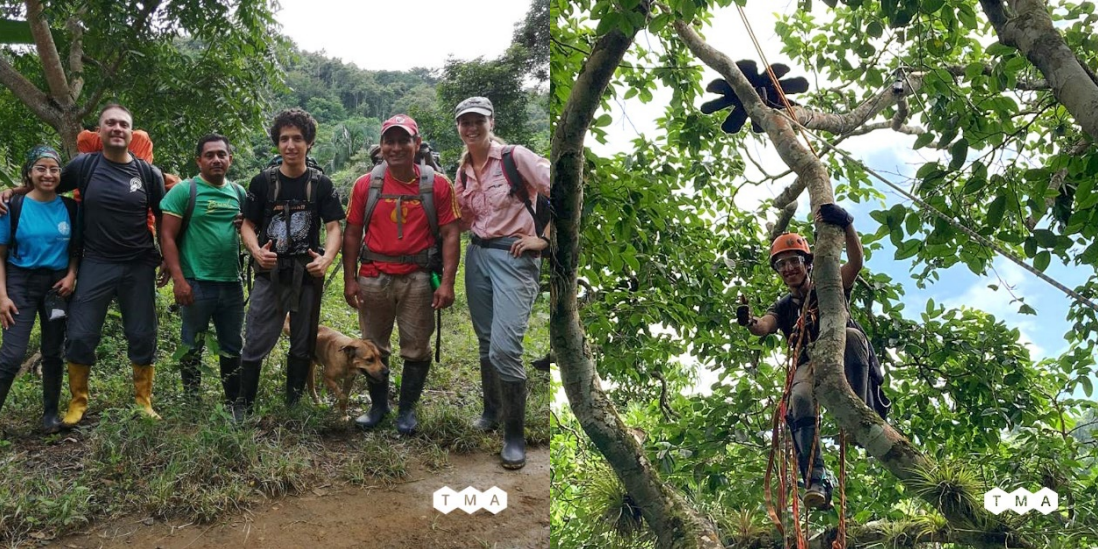
The field team (L) and a satellite-connected online audio monitoring device (R) installed in a tree canopy ® / Image credit: TMA
2. Monitor biodiversity to understand how wildlife uses the fragmented landscape and different ecosystem types
Our main focus centered on identifying 25 birds across four categories of land: intact forest, young agroforestry farms, mature agroforestry farms, and pasture. To achieve this, we deployed 30 offline audio monitoring devices (AudioMoths) in key sites from which data could be uploaded to the analytics platform at regular intervals.
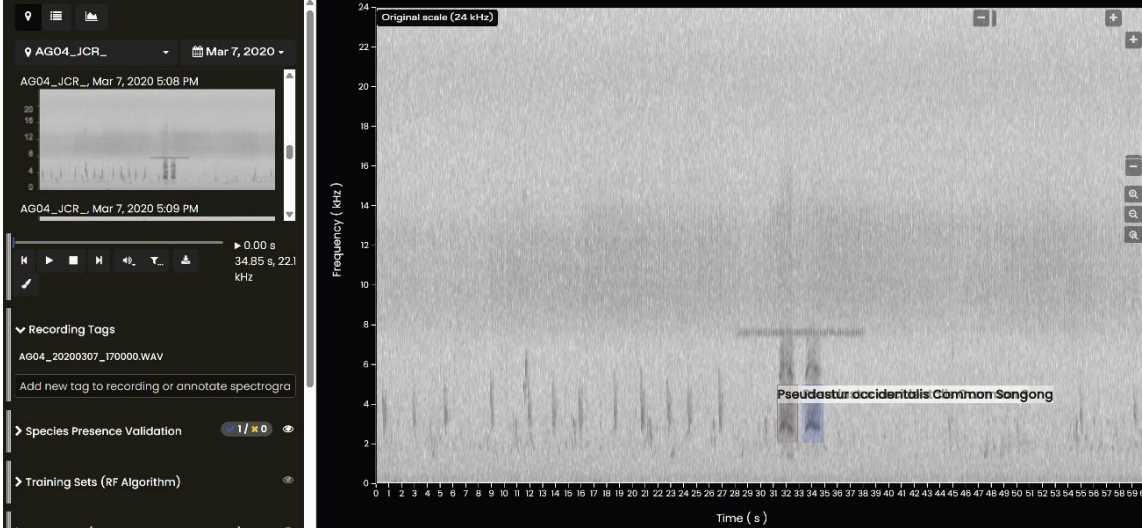
Sample of pattern matching results in the analytics platform / Image credit: TMA
By uploading the data from the offline monitoring devices, we could train the CNN model to recognize target species (i.e threatened species). This CNN model provides a solid baseline for our team to expand and automate future biodiversity analyses in the region.
Challenges
- Device maintenance: Our team had to think creatively about how to keep the canopy-based monitoring devices safe from local wildlife. On numerous occasions the devices were damaged by individuals from two local monkey species. Our team overcame this challenge by moving devices to less accessible locations in the trees and placing motion-sensing cameras near the acoustic devices to better understand why monkeys were attacking the devices.
- Threat locations: On numerous occasions our team had difficulty determining whether potential threats were detected inside JCR or outside its limits. This was to be expected given the location of the different devices - it just required our field team to do more exploratory patrols after each alert was received.
The results are in
- Conservation: The online audio monitoring devices provided significant support in monitoring the reserve for illegal activities such as logging. Detecting the sounds of chainsaws in a neighboring area enabled our park rangers to ensure that logging activities didn’t encroach into JCR.
- Research: We identified a significantly higher number of species in native forests and agroforestry than in other areas. The 25 target bird species showed a clear pattern of distribution across the landscape. The data demonstrates the importance of native forest and agroforestry in contrast to monoculture and cattle grazing, which degrade critical habitats for local wildlife.
- Biodiversity: We documented seven internationally threatened species, which we’re continuing to monitor. The CNN model identified and classified six of the seven species with a high degree of accuracy. We found that identification accuracy for the Ecuadorian capuchin monkey was lower due to the complexity of primate vocalizations.
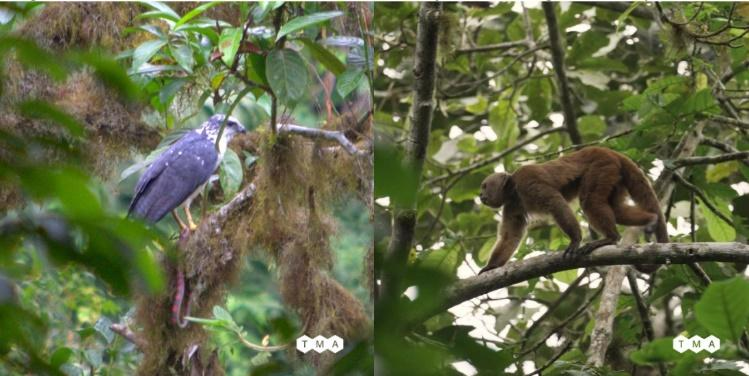
Two threatened species detected via acoustic recordings during the project – Grey-backed Hawk and Ecuadorian Capuchin monkey / Image credit: TMA
- Our team will continue to monitor existing sites, and intends to expand the project to additional sites across the landscape, including new properties that TMA has purchased over the past two years. This will drive ongoing research into species, habitats, and targeted conservation measures.
- We are also working to utilize the technology to monitor biodiversity on local cacao farms that participate in our Regenerative Agroforestry Program. This effort will help demonstrate the added benefits of helping local farmers transition their farmland to more sustainable alternatives like agroforestry, and provide an additional opportunity for local farmers to monetize their land management practices.
Ryan Lynch, Tropical Ecologist and Director of Third Millennium Alliance (TMA)

Ryan is a Tropical Ecologist with a M.S. in Wildlife Ecology & Conservation from the University of Florida. He has spent the past 20+ years working on a variety of research and conservation projects across Ecuador, including the discovery and description of numerous new frog species and the creation and expansion of two protected areas.
He has served as the Executive Director of Third Millennium Alliance (TMA) since 2014, whose mission is to protect and restore the last remnants of the Pacific Forest of Ecuador together with local communities.
Disclaimer: Any views and/or opinions expressed in this post by individual authors or contributors are their personal views and/or opinions and do not necessarily reflect the views and/or opinions of Huawei Technologies.
Leave a Comment