Tech4Nature Showcases Digital Innovation for Conservation at CMS COP15
A guest post by IUCN on Tech4Nature at CMS COP15. Huawei and International Union for Conservation of Nature (IUCN) launched the Tech4Nature global partnership in 2020 to scale up success in nature conservation through technological innovation.
Aligned with Huawei’s TECH4ALL initiative and the IUCN Green List, Tech4Nature has supported 13 projects in 11 countries with tailored solutions to conservation challenges.
At the edge of the Pantanal in Campo Grande, Brazil, delegates convened for the 15th Meeting of the Conference of the Parties to the Convention on Migratory Species (CMS COP15), held from 23–29 March 2026. The setting served as a reminder that wetlands are essential connective nodes for migratory species, a point underscored by IUCN Regional Director for South America, Gabriel Quijandría, during his intervention at the high-level segment.
Against this backdrop, Tech4Nature, IUCN’s first major partnership with the information and communications technology (ICT) sector, led a series of engagements showcasing how digital innovation, combined with strong partnerships and local participation, can strengthen conservation outcomes for migratory species and protected areas.
IUCN South America highlights Tech4Nature in discussions on wetlands, climate technology and multilevel governance
© Beatriz Barros, UICN Sur
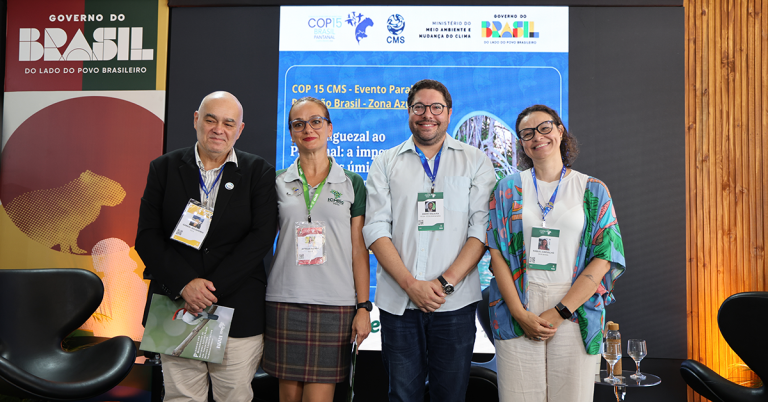
At the Brazil Pavilion, IUCN South America played a central role in shaping the technical and policy narrative on migratory species conservation. Regional Director Gabriel Quijandría led key discussions both at the Pavilion and in a technical session on fisheries governance.
IUCN South America highlights Tech4Nature in discussions on wetlands, climate technology and multilevel governance
© Beatriz Barros, UICN Sur
At the Brazil Pavilion, IUCN South America played a central role in shaping the technical and policy narrative on migratory species conservation. Regional Director Gabriel Quijandría led key discussions both at the Pavilion and in a technical session on fisheries governance.
He moderated the panel From mangroves to the Pantanal: the importance of wetlands for migratory species and the role of cooperation for conservation”, bringing together representatives from IUCN Members ICMBio, ECOA and SAVE Brasil. The dialogue explored ecological connectivity and governance, positioning wetlands not only as ecosystems but as critical natural infrastructure supporting both biodiversity and human systems.
A defining element of the discussion was the alignment of different institutional perspectives within a single analytical framework: the connection between Amazonian mangroves and the Pantanal wetlands as part of broader migratory corridors. This framing elevated the discussion beyond isolated conservation efforts and reinforced the need for integrated, cross-biome approaches.
The panel also highlighted that wetlands are among the most threatened ecosystems globally, facing increasing pressure from land-use change, hydrological disruption, fires and climate change. In this context, Gabriel guided the discussion towards governance solutions, stressing that effective conservation depends on international cooperation, policy alignment and multilevel governance frameworks.
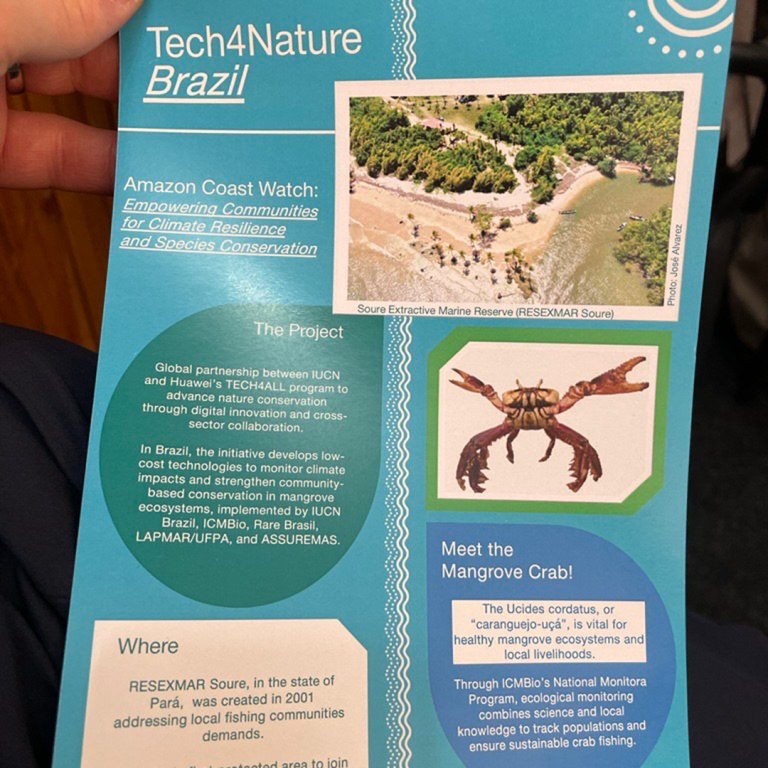
Flyer on Tech4Nature Brazil shared during the panel © James McBreen IUCN 2026
IUCN also showcased the Tech4Nature initiative in Soure (Pará), Brazil, as a concrete application of these principles, linking scientific monitoring, technology, community participation and ecosystem management. The project was presented as a replicable model aligned with CMS priorities.
Flyer on Tech4Nature Brazil shared during the panel © James McBreen IUCN 2026
IUCN also showcased the Tech4Nature initiative in Soure (Pará), Brazil, as a concrete application of these principles, linking scientific monitoring, technology, community participation and ecosystem management. The project was presented as a replicable model aligned with CMS priorities.
Later in the day, IUCN contributed to the panel “Multilevel governance for sustainable fisheries management and conservation of migratory marine species”, further reinforcing its role in translating technical concepts into actionable policy frameworks.
Gabriel highlighted that migratory marine species such as tuna, whales, sharks and sea turtles cross multiple jurisdictions, making fragmented governance ineffective. He noted that global pressures remain significant, with up to 30% of fish stocks currently overexploited, alongside growing impacts from illegal fishing, bycatch, plastic pollution and climate change.
He described multilevel governance as a structural condition for conservation success, linking decision-making across global agreements, regional fisheries bodies, national policies, and local governance and community action. In this context, he identified seven key elements of effective governance:
Gabriel highlighted that migratory marine species such as tuna, whales, sharks and sea turtles cross multiple jurisdictions, making fragmented governance ineffective. He noted that global pressures remain significant, with up to 30% of fish stocks currently overexploited, alongside growing impacts from illegal fishing, bycatch, plastic pollution and climate change.
He described multilevel governance as a structural condition for conservation success, linking decision-making across global agreements, regional fisheries bodies, national policies, and local governance and community action. In this context, he identified seven key elements of effective governance:
-
public policy frameworks
-
institutional coordination
-
monitoring and enforcement systems
-
international cooperation
-
incentive mechanisms
-
public participation
-
science-based decision-making
A strong emphasis was placed on the role of science and data, combined with local knowledge, as a foundation for avoiding stock collapse and ensuring long-term sustainability. Tools such as marine spatial planning, protected areas and fisheries zoning were identified as critical instruments aligned with ecological connectivity patterns.
IUCN reinforced these points with evidence from its global knowledge base, noting that assessments on sharks, rays and chimaeras—conducted by 353 specialists from 115 countries—demonstrate the urgency of addressing overfishing and bycatch as systemic global challenges requiring coordinated responses.
The Tech4Nature project in Soure was again highlighted as a practical example. The co-management model between ICMBio and local communities, particularly those involved in mangrove crab fisheries, illustrates how community-based monitoring, data generation and sustainable practices can strengthen both biodiversity conservation and local livelihoods.
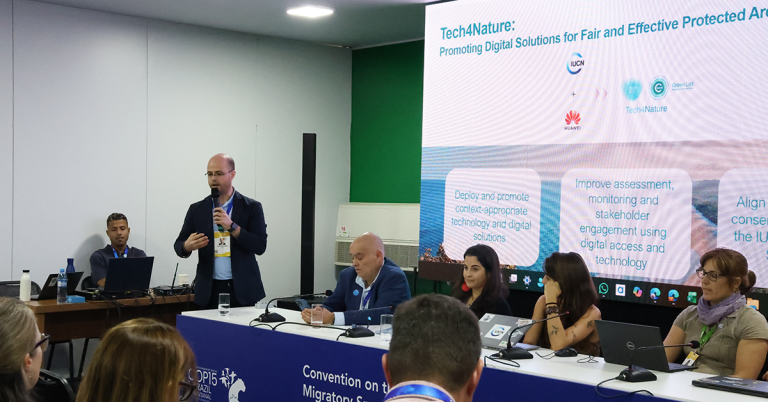
IUCN and Tech4Nature led the official CMS COP15 side event “What the Tech?! Digital innovation for migratory species and protected area conservation”.
Gabriel Quijandría and James McBreen, IUCN Senior Programme Manager, Technology and Innovation for Nature, opened the session by presenting Tech4Nature as an enabler of equitable and effective protected area management. They emphasised that the most impactful solutions emerge from combining technology with the knowledge and stewardship of local communities.
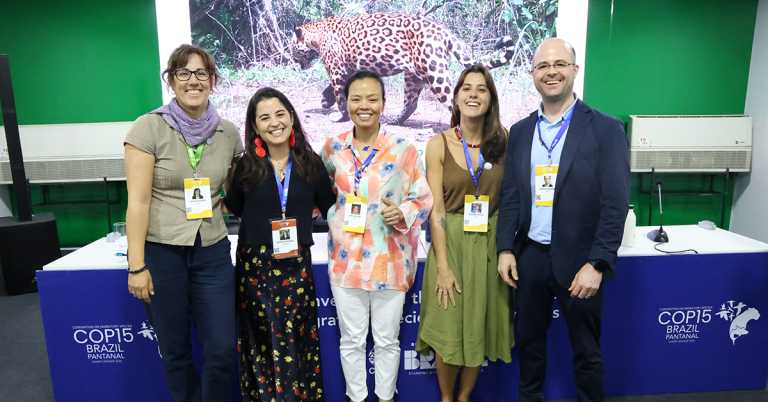
Experts from Tech4Nature Brazil, Mexico and Spain presented three examples of digital innovation. In Mexico, C Minds demonstrated how AI-powered image analysis, acoustic monitoring and citizen science platforms enhance monitoring of the jaguar—an emblematic species of CMS COP15—in the Dzilam de Bravo Reserve. In Brazil, IUCN Brazil showcased the use of low-cost climate sensors to support mangrove conservation and community-led management in the Soure Marine Extractive Reserve. In Spain, the IUCN Centre for Mediterranean Cooperation presented tools including AI-enabled camera traps, acoustic sensors and light-based monitoring systems to track migratory bird species and visitor impacts in protected areas.
These examples illustrated how real-time ecological data, community engagement and cross-border collaboration can accelerate conservation outcomes.
The session also introduced the Global Species Action Plan (GSAP) and the Species Conservation Knowledge, Information, Learning, Leverage and Sharing (SKILLS) platform. Dao Nguyen, IUCN Senior Programme Manager, Conservation Action, explained that GSAP supports implementation of the Kunming–Montreal Global Biodiversity Framework (GBF) by identifying key actions required to achieve species conservation targets.
She presented the SKILLS platform as a knowledge hub providing access to tools, resources, case studies and technologies to support implementation of GBF targets, including through the Tech4Species initiative.
Participants engaged actively in the discussion, raising practical considerations such as data verification, community engagement and partnership development. Many expressed strong interest in exploring the platform further, particularly its range of technological solutions and case studies. There was also notable interest in the Tech4Nature Award, with participants indicating plans to submit solutions through the PANORAMA platform.
The session concluded with a strong sense of collaboration and shared purpose, reinforcing commitment to advancing solutions for migratory species conservation.
© Qiulin Liu IUCN 2026
Looking ahead: Scaling responsible and inclusive digital innovation
Tech4Nature will continue to advance collaborations that embed responsible and inclusive technology within global species conservation strategies. Priorities include strengthening cross-border cooperation for migratory species, expanding community-led monitoring to ensure local ownership and sustainability, deepening partnerships with technology providers, conservation organisations and local stakeholders, and documenting and sharing lessons learned from Tech4Nature flagship and satellite projects to inform global conservation practice.
Further Reading
This article was first published on the Tech4Nature website: https://tech4nature.iucngreenlist.org/tech4nature-at-cms-cop15
Disclaimer: Any views and/or opinions expressed in this post by individual authors or contributors are their personal views and/or opinions and do not necessarily reflect the views and/or opinions of Huawei Technologies.
Leave a Comment