From Data to Impact: Scaling AI-Powered Conservation in Mexico’s Yucatán Peninsula
Huawei and International Union for Conservation of Nature (IUCN) launched the Tech4Nature global partnership in 2020 to scale up success in nature conservation through technological innovation. Aligned with Huawei’s TECH4ALL initiative and the IUCN Green List, Tech4Nature has supported 13 projects in 11 countries with tailored solutions to conservation challenges.
In this guest post, Regina Cervera, Project Coordinator for Tech4Nature México from AI for Climate at C Minds, outlines the latest updates from the flagship Tech4Nature Mexico project.
We are losing biodiversity faster than we can document it. Across Latin America and the Caribbean, protected areas face mounting pressure from deforestation, climate disruption, and the slow erosion of the governance systems that sustain them.
The tools we have relied on - fieldwork, manual data collection, periodic assessments - are no longer enough on their own. The scale of the crisis demands a different approach.
Tech4Nature Mexico is one attempt to build that approach. Since 2022, working in and around the Dzilam de Bravo State Reserve in the Yucatán Peninsula, the project has been testing whether artificial intelligence, community leadership, and cross-sector collaboration can be woven together into something more durable than a pilot: a model that generates real conservation outcomes, strengthens local governance, and can be replicated across the region.
From pilot to architecture
What began as a focused intervention in a single reserve has evolved into a multi-layered conservation system. We’ve worked with the goal of creating conditions for others to build.
The model integrates AI-powered species detection and individual identification, community-led monitoring and governance, cross-sector collaboration across government, academia, civil society, and the private sector, and data-based decision-making that reaches into public policy.
These elements, working together, are enabling us to understand the shift from pilot to replicable architecture - seeking to maintain a lasting impact beyond the project's own timeline.
What the data is telling us
Over 100,000 images and 600,000 audio recordings have been automatically analyzed. More than 140 species have been identified, many in risk categories. But the story that matters most is the Jaguar (Panthera onca).
In the first year of monitoring, three individual jaguars were recorded in the reserve. By year four, that number had grown to 16 distinct jaguar individuals identified through AI-assisted recognition and long-distance recapture data. The reserve is now understood to be a site of active life-cycle use: movement, feeding, reproduction. This is evidence that the area functions as a viable habitat, and that we now have the tools to know it, measure it, and value it.
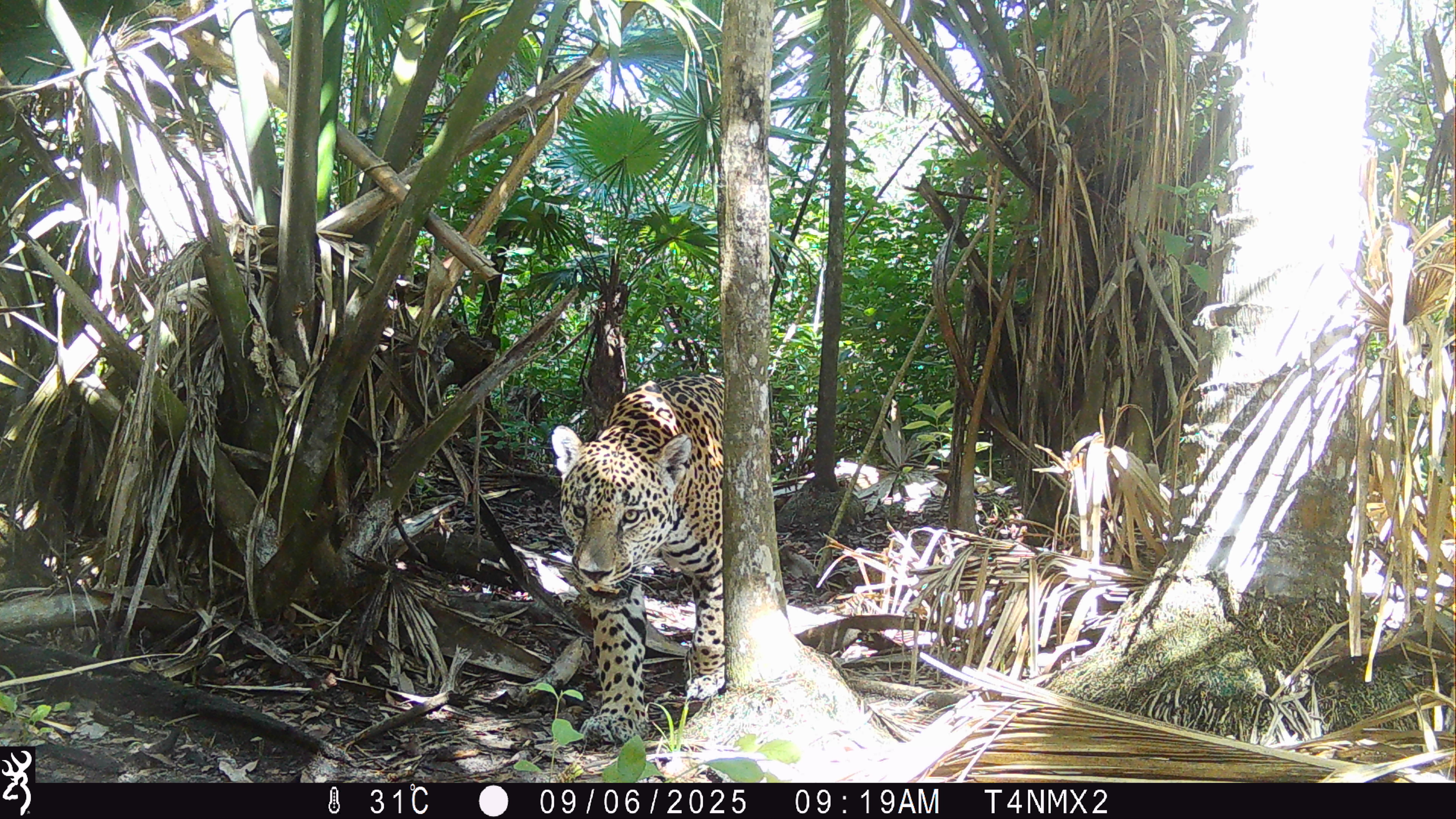
Beyond the ecological data, the landscape-level impacts are visible. The protected area expanded from 69,000 to 104,000 hectares within the first two years. A participatory process to update the reserve's management plan, developed alongside local communities and indigenous peoples in coordination with the Yucatan Government, is advancing. A transition that tends to be hard to achieve is happening: Data is becoming policy.
Technology as infrastructure
The most important lesson from this project is one that is easy to say and hard to operationalize: technology is not the goal, it is the infrastructure.
BioScanner, the AI-based open-access platform developed and deployed through the project is designed for interoperability. It integrates data across species, territories, and institutions, and is already positioned to support coordinated conservation action across the Jaguar Biocorridors of Latin America. But its value is what the platform makes possible when embedded within functioning governance frameworks, genuine community engagement, and policy processes willing to act on evidence (the most complex part).
This is the systemic argument that conservation technology often fails to make: tools gain legitimacy and long-term value not from their technical sophistication, but from the institutional and social fabric in which they operate. When that fabric is strong, when communities are partners, not beneficiaries; when local knowledge informs data design; when governance structures translate findings into decisions, the technology compounds. When that fabric is weak, no platform saves it.
The Jaguar and the People
In the Yucatán and across Mesoamerica, the jaguar is more than another mammal species. In Maya cosmology - the living tradition of the communities whose territories overlap with this reserve - the jaguar is a threshold being: the creature that moves between worlds, between night and day, between the human and the sacred.
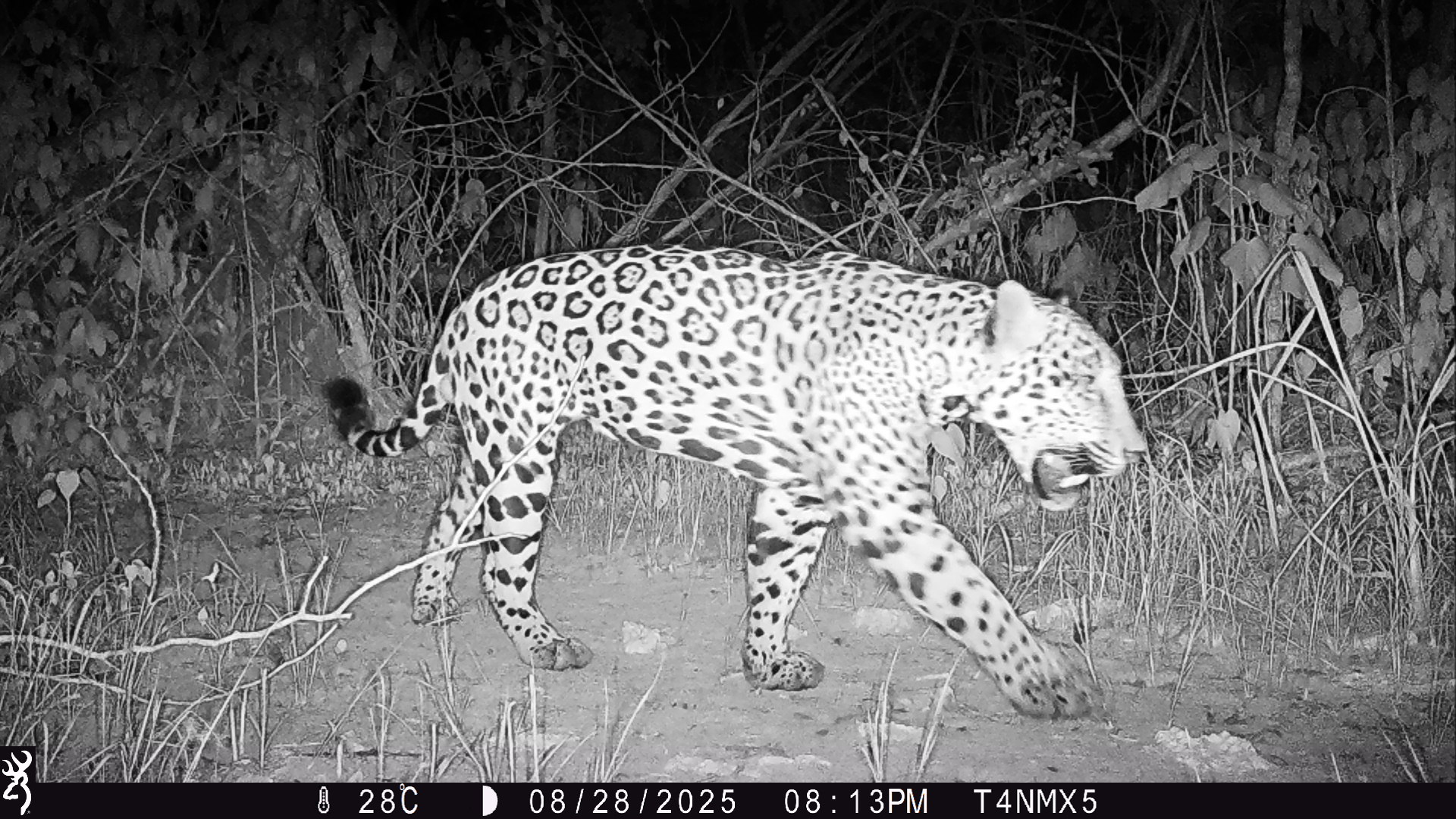
The Jaguar is associated with rain, with the cycles that govern agricultural and ecological life, with the sacred and powerful. Rulers took its name. Its image is carved into the architecture of civilizations that understood, long before modern ecology, that this animal anchors something larger than itself.
In 2025, Tech4Nature Mexico organized, in the Dzilam de Bravo community, a festival designed to bring the reserve and the Jaguar back into the center of local life: The Chac Mool Festival (in Mayan, Chac Mool means “Great Red Jaguar” or “Rain Claw”. It stands for a Mesoamerican sculpture that represents a “lying man” associated with the power of the jaguar, the underworld and the messengers between worlds. It is associated with the “Red Jaguar Throne” found in the Kukulkan Temple in Chichén Itzá).
Games for children, speakers sharing knowledge about the species, food prepared and sold by local women, handcrafts, stories. It was a deliberate act of reconnection: between communities and an animal that belongs to their landscape, and between conservation work and the question of what it is actually for.
The message the project wants to send is this: the presence of jaguars should mean prosperity. It should mean opportunities, livelihoods, pride in a territory that holds something the world increasingly recognizes as irreplaceable. Conservation that is felt only as restriction, as a limit on land use, as an outside imposition, does not last. Conservation that translates into economic opportunity, cultural visibility, and community ownership does.
This dimension has shaped the stakes of the data we generate. When AI identifies an individual jaguar moving across a landscape, confirming connectivity, confirming reproduction, confirming presence, that confirmation carries meaning beyond the ecological.
A global moment with local roots
In March 2026, CMS COP15 convened in Campo Grande, Brazil - the first time this UN wildlife conference had been hosted in Latin America, and a fitting location: the Pantanal, one of the most biodiverse wetlands on Earth, visible from the city's edge.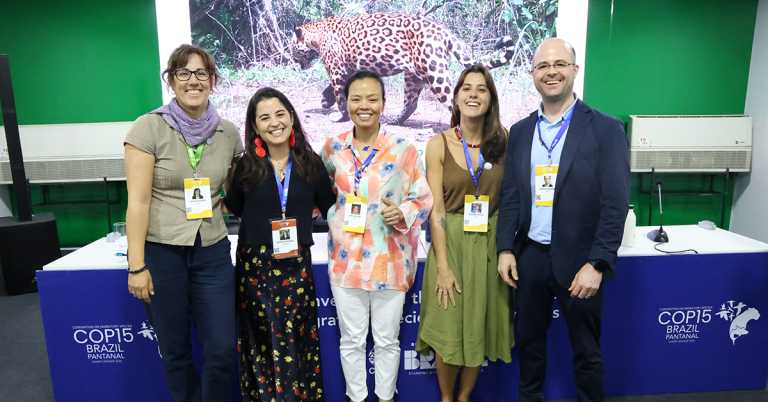
Image source: IUCN / IUCN and Tech4Nature colleagues at CMS COP15 (Regina Cervera second from left)
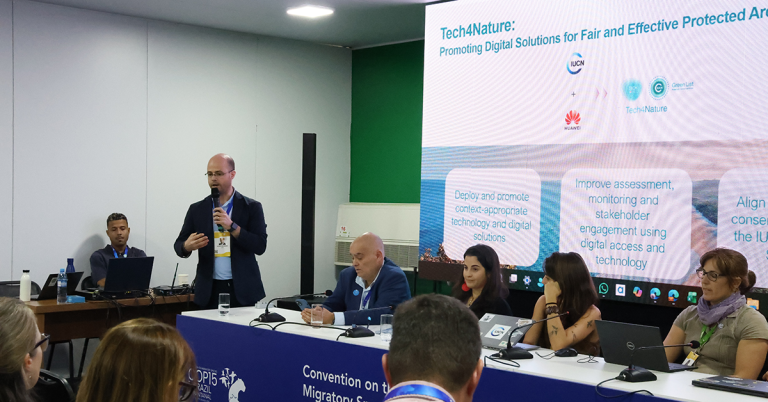
CMS COP15 © Qiulin Liu
The Tech4Nature Mexico project was featured alongside projects from Brazil and Spain. For practitioners working in the field, these convenings connect local innovation to international policy, and they make the case that what is happening in the Yucatán can serve as a transferable model.
The most significant outcome of CMS COP15 for jaguar conservation was the adoption of a Regional Action Plan, co-led by Mexico and Brazil, which reached consensus across range states in just three days. The plan promotes coordinated conservation and habitat connectivity across the jaguar's full range in the Americas. For Tech4Nature Mexico, this is both validation and responsibility. The individual identification data, the connectivity evidence, the landscape-level monitoring is precisely the scientific foundation that transboundary coordination depends on.
What comes next and what it requires
This year is focused on consolidation, scaling, and legacy. The priorities are clear: expanding BioScanner's capacity to support cross-regional data sharing across jaguar biocorridors; advancing the IUCN Green List process for the reserve as a global benchmark for effective and equitable conservation; documenting the model in ways that enable replication; and deepening the partnerships that make this work possible beyond any single project cycle.
But legacy, as we understand it, is the continuation of something that should not have to start over. The communities in and around Dzilam de Bravo have built genuine monitoring capacity. The governance relationships between local actors, civil society, and government are functioning. The data infrastructure is in place. They require sustained investment to endure.
Our call to action is to recognize what it will take to keep building. More projects like this and the willingness to invest in the long work of governance and community trust. More ambition about what conservation technology can actually do when it is designed as a system: for the benefit of local communities, for the continuity of ecosystems that the global economy depends on, and for the species that cannot wait for us to get this right.
A note from the field
Being part of Tech4Nature Mexico has confirmed something I believe deeply: conservation is not a technical problem with social dimensions. It is a social process that technology can dramatically accelerate, when that technology is co-designed, co-deployed, and genuinely in service of the people who live closest to the land.
What I will carry from this project is the collaboration: community leaders, developers, policymakers, and conservationists working toward a shared vision, not because it was required, but because each actor understood their stake in it. That is the architecture of conservation that lasts.
And for the Jaguar, as my mayan nahual - always.
Meet the author

Learn more about the IUCN-Huawei Tech4Nature global partnership.
Disclaimer: Any views and/or opinions expressed in this post by individual authors or contributors are their personal views and/or opinions and do not necessarily reflect the views and/or opinions of Huawei Technologies.
Leave a Comment