DigiSchool Morocco: Transforming Education from the Ground Up
As an ongoing partnership between Morocco’s Ministry of National Education, Preschool and Sports and Huawei Morocco, the TECH4ALL DigiSchool project in Morocco has been bridging the technology gap in education since its launch in 2024, empowering teachers and students, and helping drive the government’s national digital strategies forward.
Since its inception, I’ve worked as project manager and have seen firsthand the powerful outcomes that can be achieved by committed educators, inspired students, partnerships, and technology-driven curriculum.
In this post, I give an outline of the second phase, which launched in early 2025 and drew to a successful close in February 2026.
The DigiSchool project aims to inspire students in the real-world application of digital technology and equip teachers with the skills they need to integrate Information and Communications Technology (ICT) into the classroom. From the outset, the project has covered all 12 of Morocco’s regions, targeting rural schools which are often underserved in terms of learning resources.
DigiSchool in focus
Over 12 months, project partners implemented the following:
12 National School Roadshows
Each roadshow provided training for students and teachers in ICT skills.
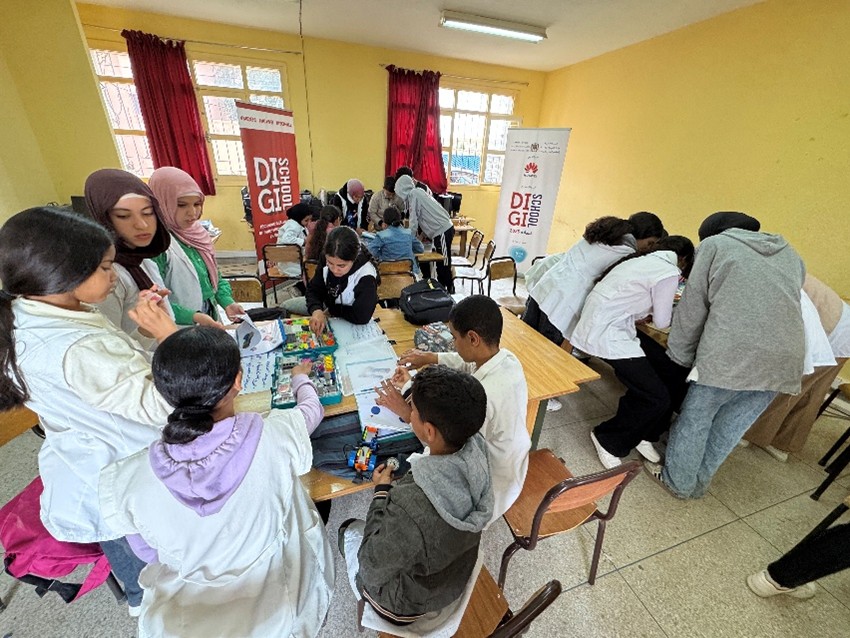
Students take part in DigiSchool roadshow activities
Skills ranged from digital literacy basics, multimedia skills, and coding to digital safety and problem-solving with technology.
For teachers, training covered areas such as digital pedagogy, content development and resource creation, digital ethics, and advanced ICT integration in teaching.
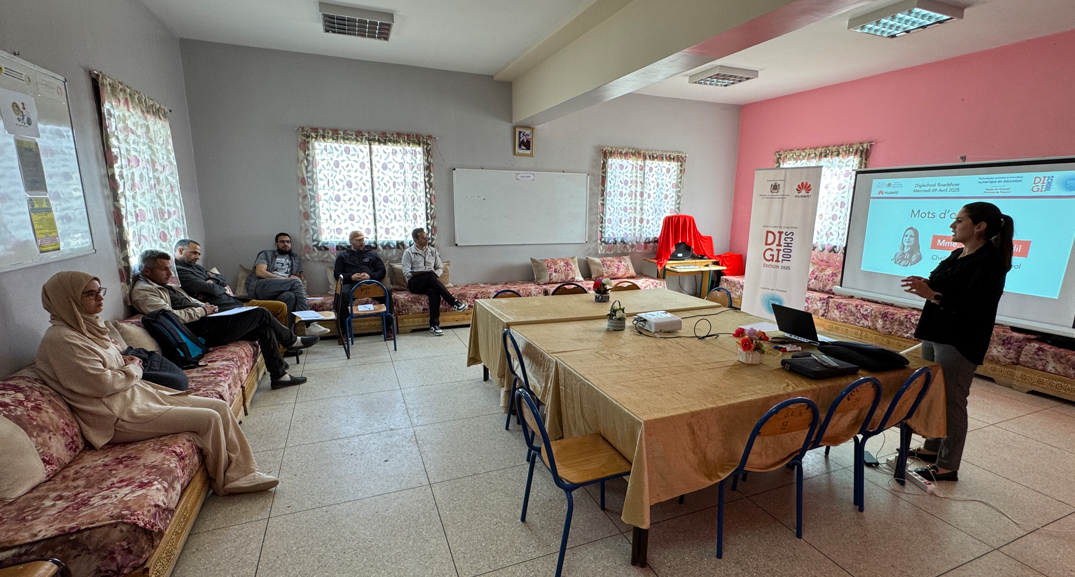
Huawei's Fadoua Fadil addresses teachers during the national roadshow
12 Regional Hackathons
The hackathons invited teams from participating schools to present tech solutions in a 5-minute pitch that outlined during which each team presented the:
- Problem
- Solution
- Prototype
- Technology
- Impact
- 5-minute Q&A
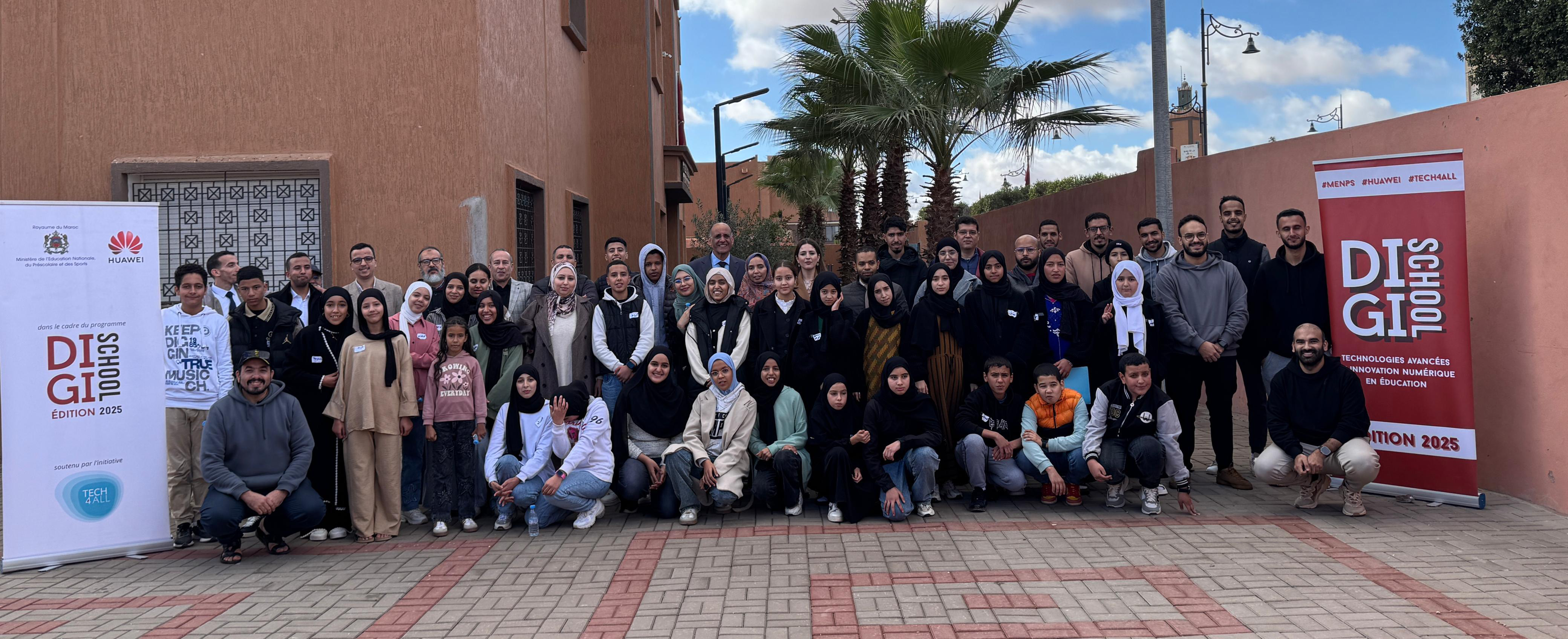
The winning teams from each of the hackathons proceeded to the final event, the National Bootcamp, which ran from February 14 to 16 in Rabat.
Side workshops at each hackathon were designed as fun, educational challenges:
The City Tech Rebuild Challenge asked teams to explore real urban challenges such as transportation, waste management, energy efficiency, education access, social inclusion, public safety, and environmental sustainability. Solutions technical skills in robotics and programming, as well as creativity, systems thinking, and human-centric problem-solving.
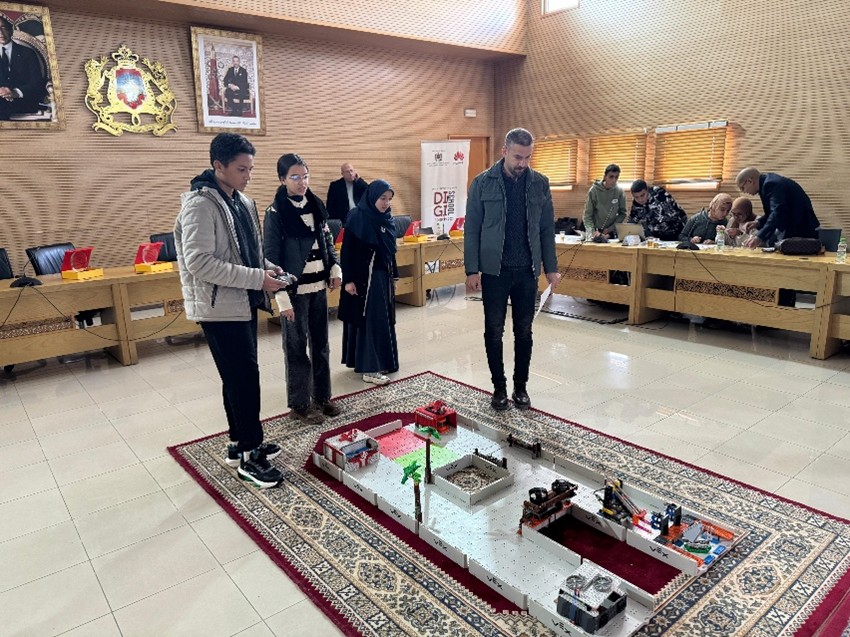
The E-Sports activity combined digital skills, teamwork, and strategic thinking in a competitive yet collaborative environment set in the structured world of esports.
Requiring communication, coordination, leadership, and quick decision-making, the event to helped students understand broader digital careers such as game design, streaming, event management, data analysis, and digital marketing.
National Bootcamp
Comprising 63 students and 13 teachers split into 12 teams – one from each of Morocco’s regions, the DigiSchool National Bootcamp was structured as a three-day intensive program combining onboarding, project refinement, pitching, and the celebration of innovation in advanced technologies and digital education.
Day 1 focused on thematic workstreams, networking, onboarding challenges, the integration of hackathon jury feedback, and a first pitch round.
Day 2 emphasized iterative improvements through prototype enhancement workshops, pitch refinement sessions, and a second pitch round.
Day 3 was dedicated to final adjustments, official pitch presentations before the jury, deliberations, and a closing ceremony with awards and group recognition. This structured progression, from feedback integration to prototype optimization and final pitching, ensured a dynamic, hands-on, and performance-oriented bootcamp experience aligned with innovation, collaboration, and continuous improvement principles.
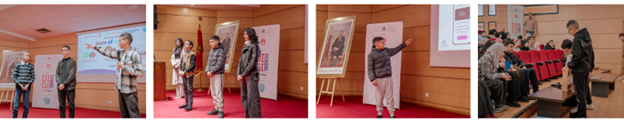
Demo Day, which took place on the final day of the event, celebrated the top teams for their excellence.
Meet the winners
We Can Do Better from Dakhla Oued Ed-Dahab
The ECO-SMART SCHOOL project by team We Can Do Better (Al-Razzi Middle School in Dakhla) addresses two major challenges affecting the school enviornment and disrupting digital learning:
- Water mismanagement
- Energy instability
Through a functional prototype and engagement of the Digi Students Clud, the project integrates environmental responsibility, digital innovation, and Design Thinking methodology to foster student leadership and build a more resilient eco-conscious model with potential for regional and national scaling.
DIGICARTE from Tanger Tetouan El Hoceima
Digicarte is an innnovative digital attendance and school access solution designed to address:
- recurring student absenteeism
- administrative overload
- loss of instructional time caused by manual attendance when scanned at the school entrance
In cases of absence, a notification SMS is automatically sent to parents. The device integrates and intelligent security feature that blocks unauthorized access ateempts using unregistered cards., triggering a red warning light thanks to a sensor connected to the classroom control system.
Developed using an Arduino Uno board and sensor technology, the prototype was built following a Design Thinking methodology to ensure a structured and collaborative approach. With future plans to integrate fingerprint recognition for enhanced security and broader institutional scalability, Digicarte represents a practical step toward a more efficient, secure, and digitally managed school environment.
Les Champions from Rabat Sale Kenitra
Under the Rabat-Sale-Kenitra Academy, Les Champions proposed MagicWall, an affordable and innotive solution that transforms a simple wall projection into a touch-interactive interface with a budget of less than 200 MAD.
Addressing the limitations of traditional video projectors and passive classroom interaction, the team designed a low-cost system that enables teachers and students to interact dynamically with projected content, enhancing engagement, memorization, and pedagogical comfort while democratizing access to advanced educational tehcnology.
Developed through a Design Thinking approach (empathy, definition, ideation, prototyping, and testing), the prototype restores teacher mobility, reinforces classroom authority, and reduces costs for schools.
Future development plans include local production of plug-and-play kits, a mobile calibration application, and a gesture-recognition version without a stylus, positioning MagicWall as a scalable and inclusive digital innovation for pioneer schools.
Noor from Souss Massa
Noor project introduces an inclusive technological solution designed to support deaf students by replacing the traditional sound-based school bell with a synchronized green LED light system connected to the school timetable.
By activating visual signals during class transitions, the system eliminates confusion, prevents delays, and promotes autonomy for deaf learners, ensuring smoother movement between lessons and full participation in school life.
Built around a simple low-cost central control unit with both automatic and manual operation options, Noor embodies an inclusive, practical, and scalalbe approach that reinforces equal oppotunity and contributes to creating a more equitable and accessible educational environment.
Teacher awards
Three teachers also received awards from the Teachers’ Track of the Bootcamp:
- Adnane El Ismaili from Oriental
- Abderrahim Assous from Fès Meknès
- Youssef Amekrane from Drâa Tafilalet
As well as the awards presented to the winning teams, the ceremony also highlighted the essential role of teachers as true catalysts for innovation. Eight teachers were honored for outstanding pedagogical projects, which enriched the learning experience and strengthened digital culture within their respective institutions.
Overall project outcomes
- 12 Regional Academies of Education and Training (AREFs) covered
- 48 new schools reached
- 502 teachers trained
- 3,171 students trained
- 100 fairs nationwide to showcase teacher and student projects
Closing ceremony
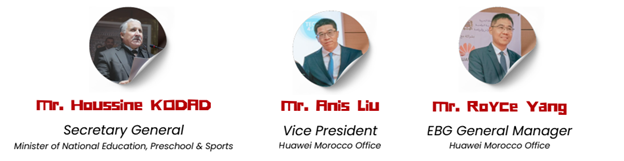
The closing ceremony for the second edition of DigiSchool Morocco also took place at the National Bootcamp.
Senior representatives from the Ministry of National Education, Preschool and Sports and Huawei honored the winning teams, and the teachers who contributed to the success of the DigiSchool program, reaffirming the strong commitment of all stakeholders to the development of digital skills in Morocco.
Implementing a project on a national scale is not without its challenges, but the outcomes and continued momentum of the DigiSchool Morocco project makes a challenging journey extremely worthwhile and one that I am excited to continue.
Disclaimer: Any views and/or opinions expressed in this post by individual authors or contributors are their personal views and/or opinions and do not necessarily reflect the views and/or opinions of Huawei Technologies.
Leave a Comment