Project ORION: How We Built an AI Guardian to Protect Ghana’s Forests
The Huawei ICT Competition is an annual global event designed for students and teachers from colleges and universities. It offers an international platform for competition and exchange, enabling participants to strengthen their ICT knowledge, improve practical skills, and foster innovation using the latest technologies and platforms. Since its launch in 2015, the competition has been gaining significant momentum, with more countries and students joining each year. In China, it has been listed as a national competition for university students, while globally, it has been recognized as a key partner flagship program by UNESCO's Global Skills Academy.
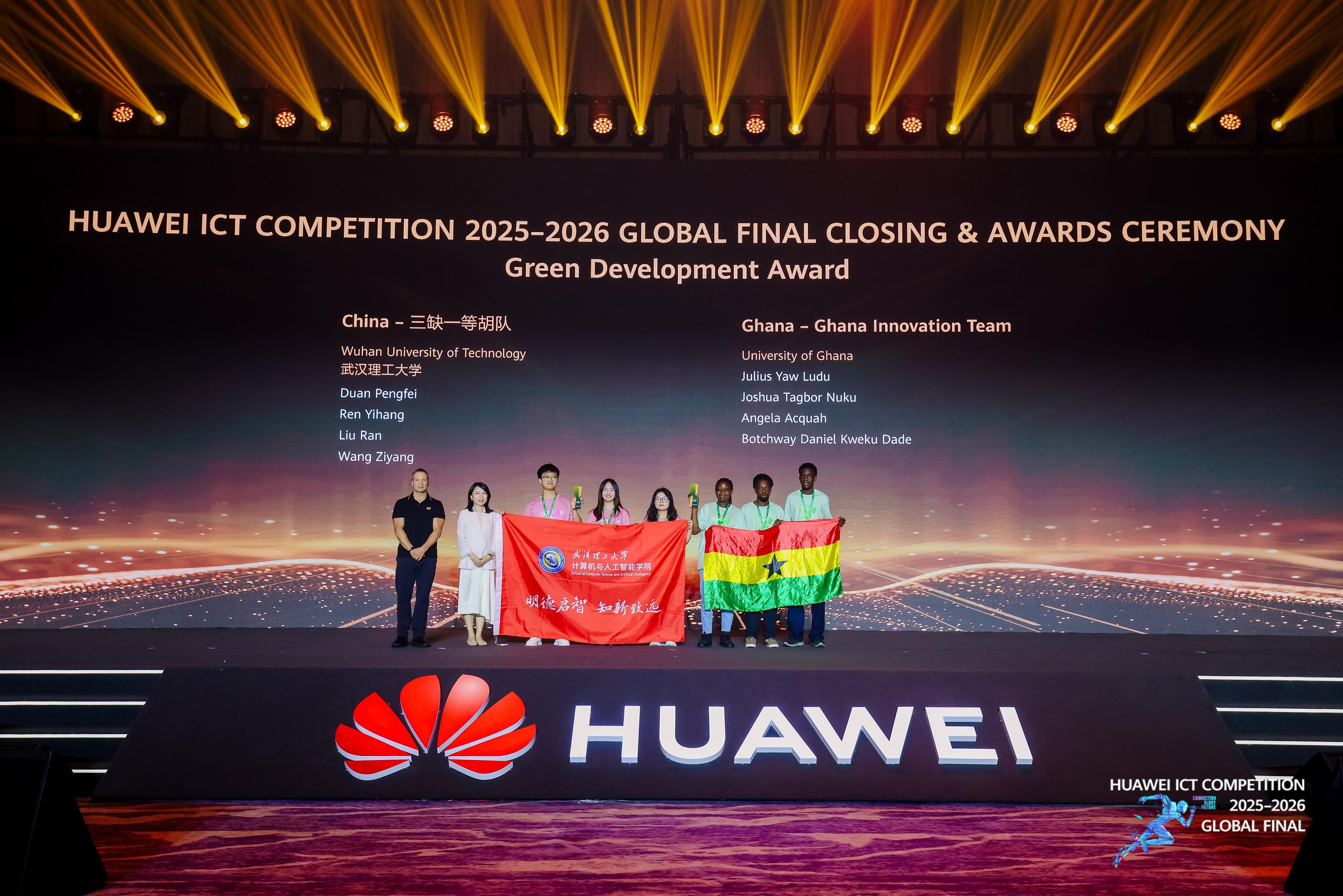
Team Terra Sentry receive the Green Development Awards at the Huawei ICT Competition 2025-2026 awards ceremony / Image credit: Huawei

Image credit: Terra Sentry
As computer science and engineering students at the University of Ghana, we wanted to build a technological shield against this ecological crisis. The problem we faced was one of scale. Protected forests are vast and remote. Traditional manual ranger patrols are incredibly dangerous, infrequent, and entirely reactive. Commercial surveillance drones are loud, visible, and prohibitively expensive to operate continuously. Authorities were essentially blind in the deep forest.
We realized that to protect the forest, we needed a solution that was real time, completely autonomous, and completely invisible. This was the beginning of Project ORION (On-site Real-time Intelligence Observation Network).
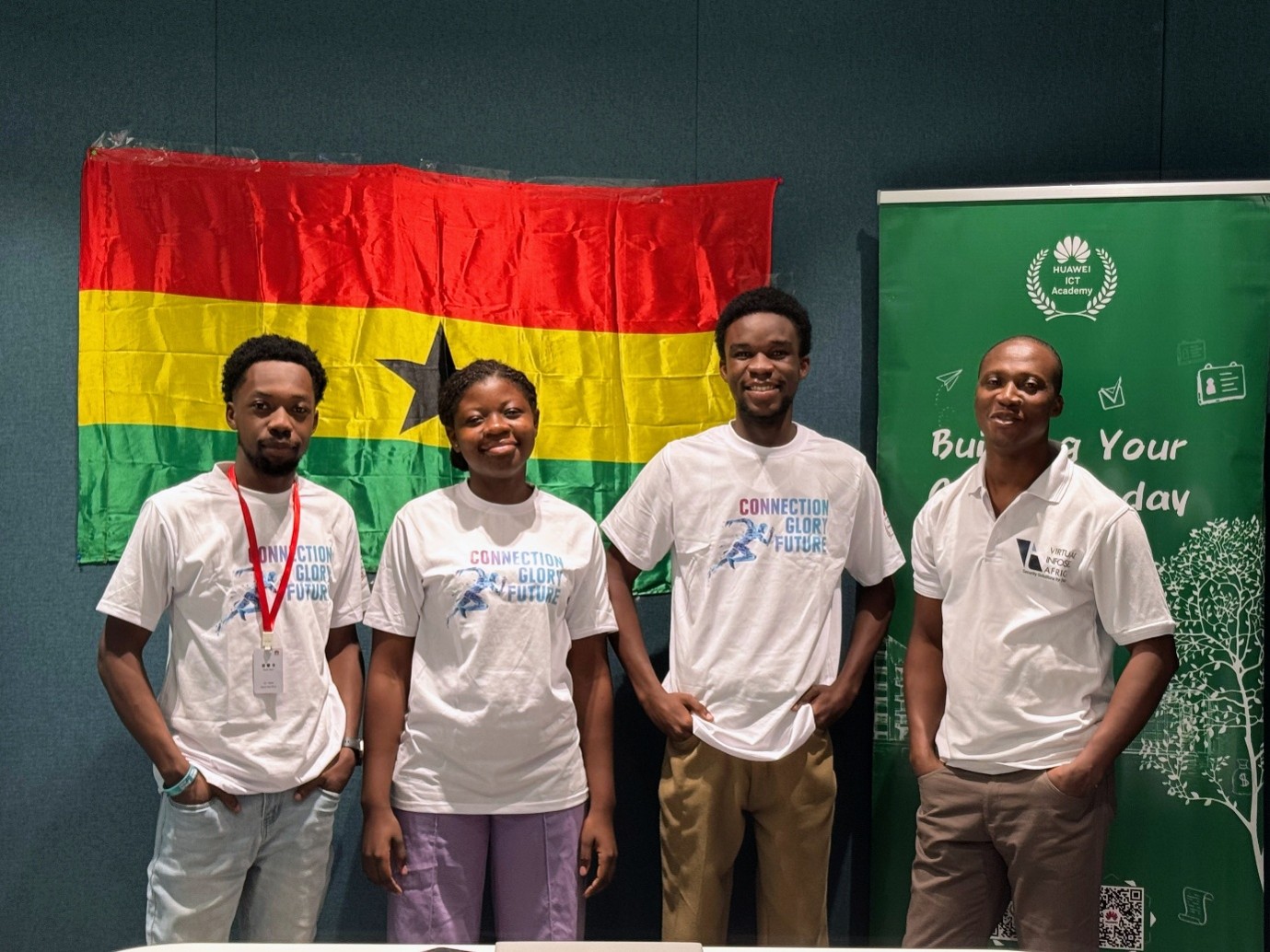
Team Terra Sentry L to R: Joshua Nuku, Angela Acquah, Daniel Botchway and team mentor Mr. Julius Ludu / Image credit: Terra Sentry
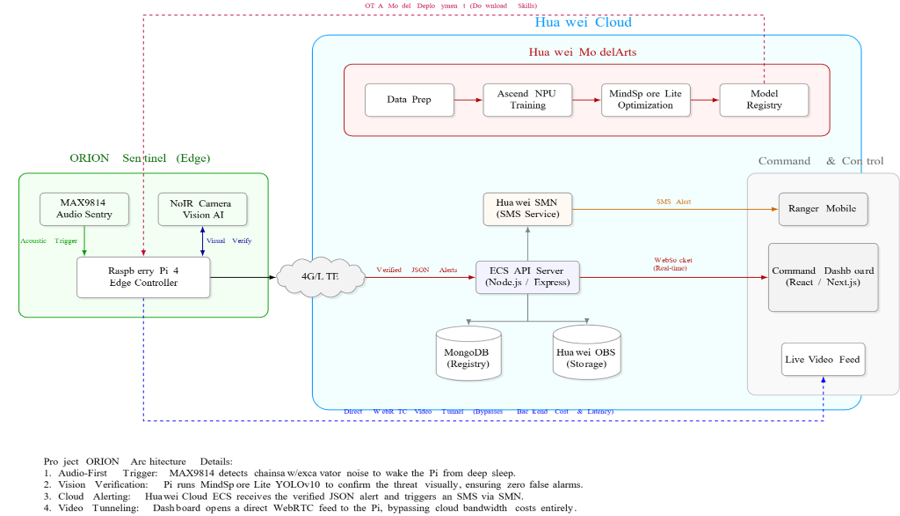
ORION system architecture / Image credit: Terra Sentry
To achieve this, we engineered an innovative Audio First pipeline. In the jungle, running a camera and computer vision 24/7 drains edge device batteries in a matter of hours. So, 99 percent of the time, the ORION Sentinel camera is completely off. The device rests in an ultra-low power state, using a high sensitivity microphone to listen for the specific acoustic signatures of heavy excavators, dredges, or chainsaws.
The leap from a university science project to an enterprise grade solution happened when we entered the Huawei ICT Competition. We quickly realized that training a complex, multi class object detection model on our local laptops was practically impossible. Through the competition, we gained access to Huawei ModelArts. By harnessing the immense parallel computing power of Huawei Ascend 910B NPUs, a training process that would have taken us days was completed in minutes.

Hardware / Camouflage Unit / Image credit: Terra Sentry
When the acoustic trigger fires in the forest, the system wakes up a NoIR night vision camera and runs our custom object detection model. We utilized MindSpore Lite to convert and quantize our model, allowing us to deploy it directly onto the edge device. Running locally, MindSpore visually verifies an excavator with over 92 percent accuracy in less than 350 milliseconds.
If the AI visually confirms the threat, it bypasses false alarms and sends a lightweight JSON payload over a 4G network to our Huawei Cloud Elastic Cloud Server (ECS) backend. Within seconds, a centralized Command Dashboard updates with a red alert, and an SMS is dispatched to a ranger’s mobile phone via the Huawei Cloud Simple Message Notification (SMN) service. From the dashboard, rangers can open a direct, peer to peer WebRTC video tunnel to the device, verifying the threat with their own eyes before deploying a team safely.
Because illegal miners will destroy any surveillance equipment they see, we housed our Sentinels in custom, IP67 rated biomimetic enclosures designed to look exactly like tree bark or termite mounds. They hide in plain sight.
When the acoustic trigger fires in the forest, the system wakes up a NoIR night vision camera and runs our custom object detection model. We utilized MindSpore Lite to convert and quantize our model, allowing us to deploy it directly onto the edge device. Running locally, MindSpore visually verifies an excavator with over 92 percent accuracy in less than 350 milliseconds.If the AI visually confirms the threat, it bypasses false alarms and sends a lightweight JSON payload over a 4G network to our Huawei Cloud Elastic Cloud Server (ECS) backend. Within seconds, a centralized Command Dashboard updates with a red alert, and an SMS is dispatched to a ranger’s mobile phone via the Huawei Cloud Simple Message Notification (SMN) service. From the dashboard, rangers can open a direct, peer to peer WebRTC video tunnel to the device, verifying the threat with their own eyes before deploying a team safely.
Because illegal miners will destroy any surveillance equipment they see, we housed our Sentinels in custom, IP67 rated biomimetic enclosures designed to look exactly like tree bark or termite mounds. They hide in plain sight.
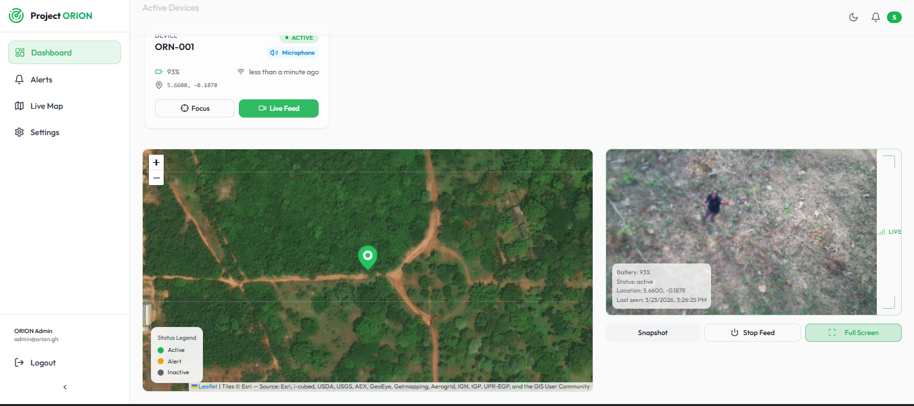
Command dashboard UI / Image credit: Terra Sentry
Traveling to Shenzhen, China, for the Global Finals was the culmination of months of hard work. To be chosen from over 200,000 participants across 100 countries, and to stand on the global stage, was a profoundly humbling experience. The Huawei ICT Competition did not just give us a platform; it provided the enterprise grade infrastructure that empowered us to build a commercially viable product.
Winning the Third Prize and the Green Development Award proved to us that when you combine a deep empathy for your environment with world class technology, the impact is limitless. We proved that for the price of a single commercial surveillance drone, governments can deploy a 24/7, invisible AI network to guard our most vulnerable ecosystems.
The forest is no longer blind. The forest is watching. And this is just the beginning.
Video credit: Terra Sentry
Disclaimer: Any views and/or opinions expressed in this post by individual authors or contributors are their personal views and/or opinions and do not necessarily reflect the views and/or opinions of Huawei Technologies.
Leave a Comment