Tech4Nature Award Winner: Building Sustainable Rangelands in Africa with Local Communities
At the inaugural IUCN-Huawei Tech4Nature Awards in 2025, African People & Wildlife (APW) won the NatureTech Steward Award for its Sustainable Rangelands Initiative. In this guest post, Neovitus Sianga, Director of Conservation and Environment for APW, explains how community and tech are coming together to protect Africa’s grassland ecosystems.
Africa’s biodiversity faces serious, growing threats that need bold and urgent action. Half of Africa’s wild species face the risk of extinction by the year 2100. Africa is rich in natural resources, but overuse and exploitation threaten the futures of people and wildlife. To survive and thrive, Africa’s rural people and wildlife species need large, intact ecosystems that span across protected and communal lands.
African People & Wildlife (APW) prioritizes delivering win-win solutions to help people and nature thrive together – today and tomorrow.
Sustainable Rangelands
APW’s Sustainable Rangelands Initiative keeps grasslands open and flourishing for the long-term benefit of rural communities and wildlife. Taking a holistic, community-driven approach guided by ACTIVE™ (Access, Connect, Team, Implement, Verify, Evolve), our team trains and deploys community habitat monitors, and collaborates with village leadership to restore vital habitats.
Through monthly data collection, habitat monitors use state-of-the-art mobile technology to provide updates on pasture quality to natural resource decision-makers in their communities. A suite of customized Esri geo-spatial applications and tools, including Survey123, ArcGIS Dashboards, and ArcGIS Hub, have been designed by the APW team to generate a long-term pasture quality dataset. This invaluable dataset streams in real time into culturally relevant visualization tools that inform conservation interventions. Results including increased grass height, increased vegetation cover, and the reduction of invasive and problematic plant species have been observed in these community-managed grazing areas.
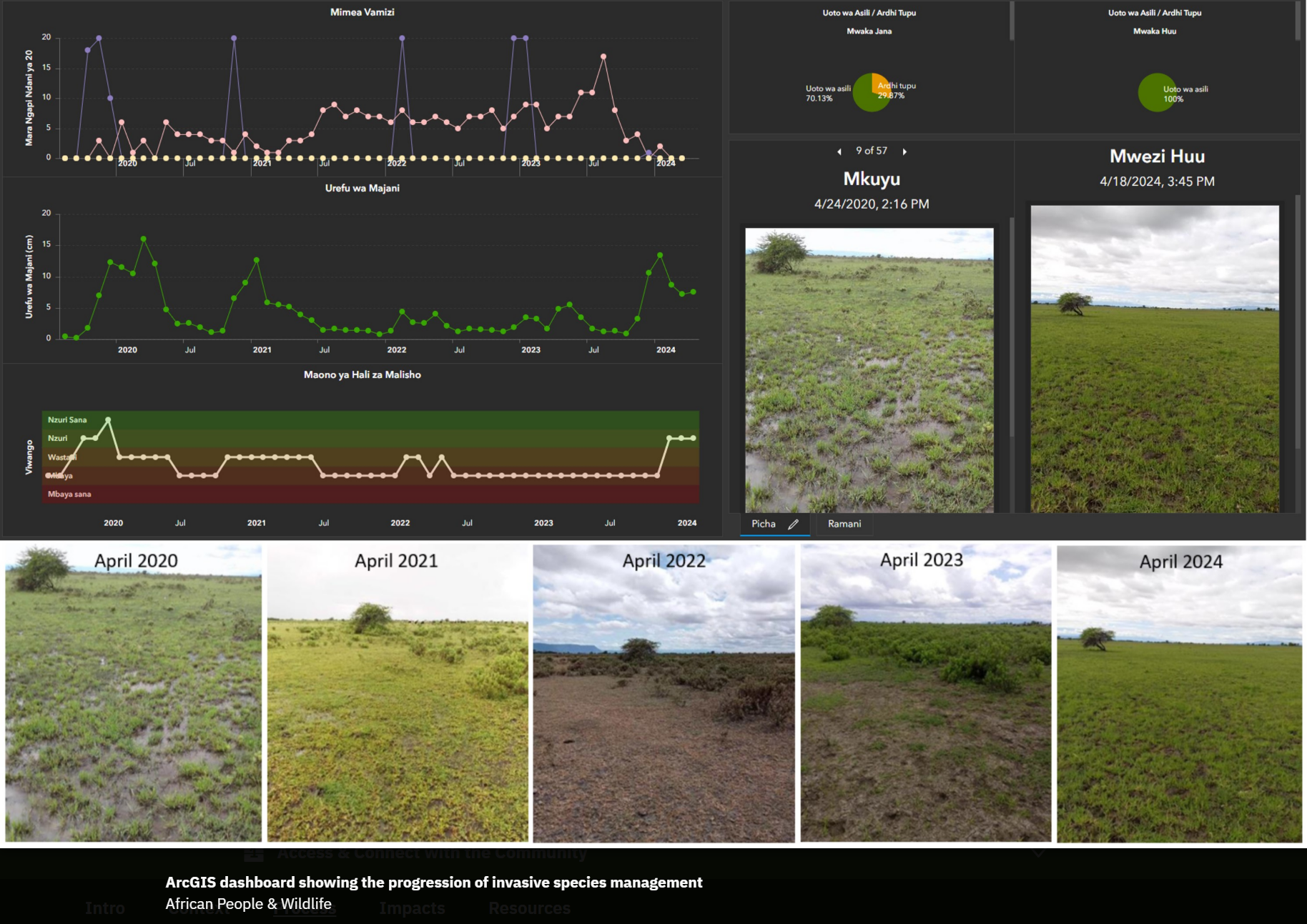
Image source: African People and Wildlife
Our conservation efforts are tailored to the specific needs and aspirations of the community, creating a strong foundation for sustainable, inclusive, and innovative solutions. We begin with preparatory activities, including a pastoral livelihoods and rangeland management dialogue, which fosters open communication and builds trust. Focusing on understanding the unique governance structures and rangeland management practices already in place, we conduct a participatory mapping exercise to identify critical pastures used by the community and wildlife alike. A plot ID – coded with both indigenous and scientific names – is designated for each pasture. Baseline quality data is collected using a customized Survey123 form for site selection and assessment.
The data include both ecological metrics (e.g., grass height, soil type) and social factors (e.g., cultural significance, accessibility).
The process
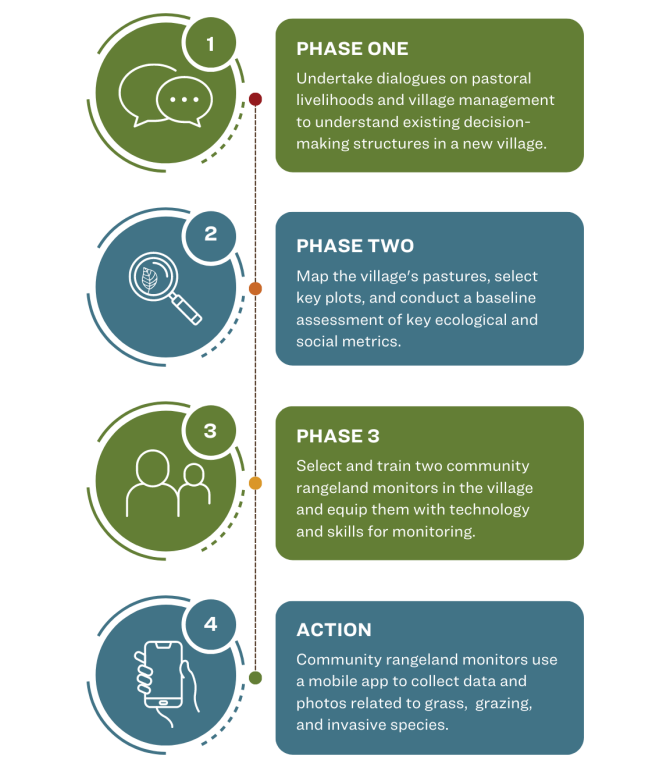
Image source: African People and Wildlife / Collected data is uploaded to APW's ArcGIS Online portal for analysis. Recommendations for interventions are discussed with the grazing committee at rangeland feedback meetings
Tanzania People and Wildlife
Tanzania People & Wildlife (TPW) is APW’s sister organization. We are a registered nonprofit organization that implements our programs in the United Republic of Tanzania.
Tanzania’s rangelands are key to the survival of pastoralists that depend on grasslands for their livestock, wildlife that forage alongside livestock, and the carnivores that prey on these wild species. As human and livestock populations grow, pressure on these ecosystems intensifies, causing overgrazing, habitat loss, and growing conflict over resources.
Both pastoralists and wildlife require mobility to adapt to seasonal changes. To sustain this mobility, it is essential to keep movement corridors open. Achieving this requires coordinated action, shared understanding, and information exchange across village boundaries and governance levels.
While there is a perception that rural and Indigenous people do not or cannot use modern technology for data collection and conservation action, our experience proves otherwise. The use of technology allows for evidence-based collective decision making at a pace and scale needed to foster more resilient and productive grasslands that support people and wildlife.
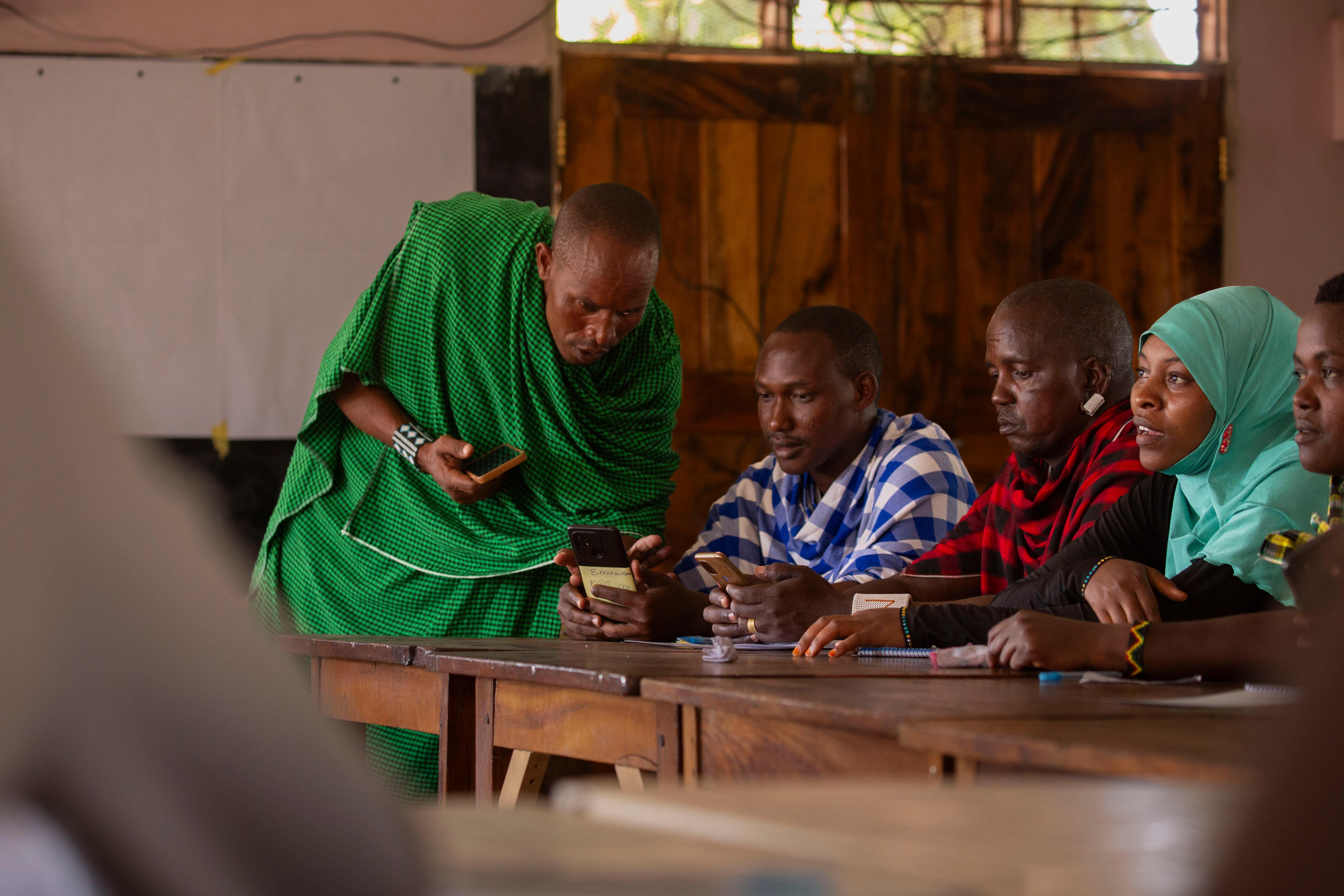
Image credit: Emmily Tunuka
APW’s Sustainable Rangeland Initiative has supported communities in the management of over 800,000 acres of grassland. Spanning across 50 villages in northern Tanzania, the program has actively restored 20,000 acres of grasslands – uprooting invasive and problematic species and implementing soil erosion prevention. As the program has developed, the village-based model has transitioned to a landscape approach to ensure continuity in management and connectivity for ecological benefits.
Since 2020, APW has conducted harmonization meetings that unite stakeholders from the village level, wards, divisions, districts, regions, different ministries, parastatal institutions, and NGOs to discuss rangeland management and policy agendas. Our approach has been formally recognized by the Ministry of Livestock and Fisheries and will inform future policy – a remarkable accomplishment that ensures the voices of rural pastoralists are included in the natural resource management decisions upon which their lives and livelihoods depend.
APW was honored to receive Esri’s prestigious Special Achievement in GIS (SAG) Award for the organization’s innovative application of mapping and analytics technology as well as thought leadership in the field of conservation. Subsequently, APW’s customization of the Esri suite of applications and back-end coding has been adopted in other landscapes.
Learn more about the Sustainable Rangelands Initiative solution.
Further reading
African Wildlife and People [website]
Panorama Solutions [profiles and promotes cutting-edge nature conservation solutions, including the three IUCN-Huawei Tech4Nature Award winning solutions]
The Tech4Nature Award [blog post]
About the Author
Neovitus Sianga, Director of Community Conservation and Environment, African People and Wildlife

Neovitus Sianga is the Director of Community Conservation and Environment for African People & Wildlife, guiding a portfolio of initiatives that strengthen natural resource stewardship across northern Tanzania.
With more than a decade of experience in people-centered conservation, Neovitus brings both practical insight and deep local knowledge to his role. He holds a bachelor’s degree in educational psychology and a master’s degree in natural resource assessment and management from the University of Dar es Salaam. Drawing on these foundations, Neovitus works closely with rural and Indigenous communities to advance approaches that reflect both ecological realities and the needs of local people.
His leadership has supported the design and expansion of programs that improve grassland and savanna health, enhance biodiversity, and reinforce community-led conservation. A consistent advocate for inclusive dialogue, he integrates traditional wisdom with applied science to promote collaborative problem-solving and resilience in the face of environmental change.
Neovitus has represented APW on national and international platforms. His work has been recognized through several awards, including the Sydney Byers Award for Excellence in Conservation, the Disney Conservation Hero Award, and the IUCN-Huawei Tech4Nature Award, which he accepted on behalf of the organization at the World Conservation Congress in 2025.
Disclaimer: Any views and/or opinions expressed in this post by individual authors or contributors are their personal views and/or opinions and do not necessarily reflect the views and/or opinions of Huawei Technologies.
Leave a Comment